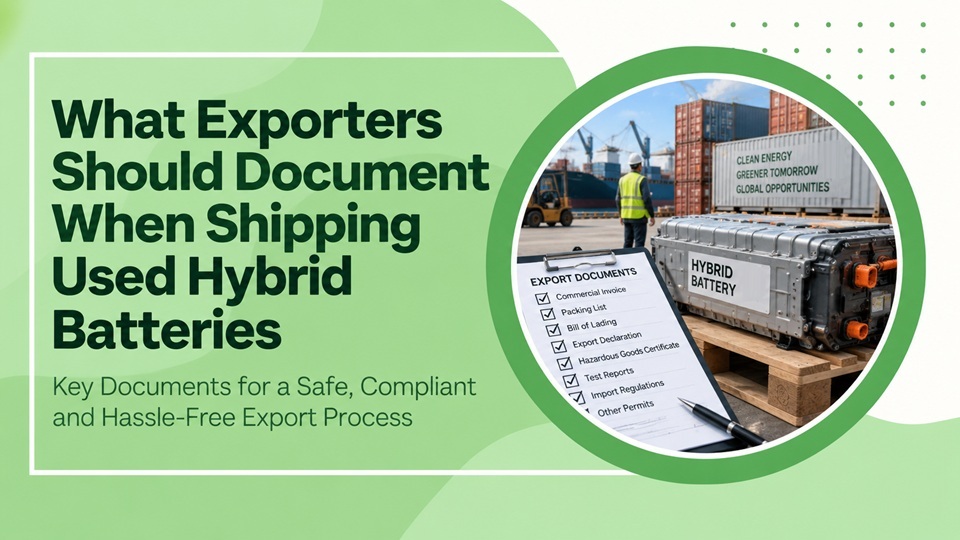
Exporting used hybrid vehicle batteries involves more than arranging freight and preparing a commercial invoice. These products may be regulated as dangerous goods, their condition can vary, and authorities or carriers may request evidence about chemistry, testing, packaging, origin, value, and intended use. Missing or inconsistent records can lead to customs delays, rejected cargo, unexpected storage charges, or disputes after delivery.
A disciplined documentation process protects every party in the transaction. It helps exporters demonstrate responsible handling, gives importers the information needed for clearance, and allows workshops, distributors, and fleet maintenance teams to verify that an order matches their requirements. The following framework explains what should be recorded before used hybrid batteries leave the warehouse.
Start with an Accurate Product Identification Record
Every shipment should begin with a clear inventory list. Generic descriptions such as “car parts” or “used auto items” are rarely sufficient and can create unnecessary questions. Each line item should identify the product in commercially and technically meaningful terms.
Record the vehicle make, model, generation or applicable year range, battery chemistry, nominal voltage, quantity, and part number where available. State whether the shipment contains complete battery packs, modules, or individual battery cells. Exporters should also record serial numbers or internal stock references whenever practical, especially for high-value or mixed-model consignments.
The same terminology should appear across the quotation, invoice, packing list, inspection record, and shipping instructions. If one document describes complete packs while another describes modules, a carrier or customs officer may treat the discrepancy as a compliance concern.
Document Condition and Intended Commercial Use
Used components require a more detailed condition statement than new goods. Exporters should distinguish products intended for continued use from damaged, defective, scrap, or recycling-only material. This distinction can affect dangerous-goods acceptance, waste-shipment controls, import eligibility, and customs classification.
A useful condition file may include:
-
A statement that the units are used and intended for reuse, resale, repair, or installation, as applicable.
-
Visual inspection results covering cracks, leakage, corrosion, burned areas, deformation, and damaged terminals.
-
Photographs showing the products before packing and after they are secured.
-
Identification of any rejected or segregated units.
-
The inspection date and the name or reference of the responsible inspector.
Exporters should never describe untested or damaged products as serviceable simply to obtain carrier acceptance. Besides creating legal and safety risks, an inaccurate declaration can damage relationships with importers and logistics providers.
Maintain Testing and Inspection Evidence
Business buyers need more than a broad assurance that stock is “good.” A testing record should explain what was checked and connect the result to the relevant unit or batch. Depending on the product and the exporter’s process, records may include voltage readings, physical-condition checks, connector observations, and confirmation that terminals were protected before dispatch.
Testing documentation should not promise performance beyond what the test actually establishes. A voltage reading, for example, is useful evidence of condition at a particular time, but it is not automatically a guarantee of capacity, remaining service life, or compatibility. Reports should therefore state the test date, equipment or method used, measured result, and acceptance criteria without making unsupported claims.
This is one reason reliable upstream sourcing matters. Hybrid Hive, a wholesale supplier based in Sharjah, sources used hybrid battery inventory through trusted Japanese supply channels and applies dual inspection and voltage testing before preparing stock for commercial buyers. Its process is designed for distributors, workshops, importers, resellers, and fleet teams rather than casual retail transactions.
Confirm the Dangerous-Goods Classification
Battery transport requirements depend on factors including chemistry, design, condition, mode of transport, route, and whether a battery is shipped alone, packed with equipment, or installed in equipment. Nickel-metal hydride and lithium-ion products are not documented identically. Damaged or defective units may also face stricter restrictions than serviceable used products.
Before booking, exporters should ask a qualified dangerous-goods specialist or the selected carrier to confirm:
-
The applicable UN number and proper shipping name, if regulated.
-
The relevant hazard class, packing group where applicable, and required marks or labels.
-
Whether a shipper’s dangerous-goods declaration is required.
-
Whether a safety data sheet or technical product information is requested.
-
Whether a UN 38.3 test summary is applicable and available for lithium battery designs.
-
Any state, airline, vessel operator, port, or carrier-specific restrictions.
Requirements can change, and carrier policies may be more restrictive than the underlying transport regulations. Exporters should verify current rules for road, sea, or air transport rather than reusing documentation from an earlier shipment without review.
Build a Complete Commercial and Customs File
The commercial invoice should identify the seller and buyer, provide an accurate product description, show quantities and unit values, state the currency and total value, and include the agreed Incoterm. It should also record the country of origin as supported by the available sourcing documents. The country of export or warehouse location should not automatically be presented as the manufacturing origin.
The packing list should reconcile with the invoice while adding logistics detail: package count, net and gross weight, dimensions, pallet references, and the contents of each package. Exporters should confirm the appropriate HS classification with a customs professional because classification may depend on the product’s form and destination-country rules.
Import permits, certificates, waste-status declarations, or pre-shipment inspections may be required in some jurisdictions. The importer or customs broker should confirm these requirements before cargo is collected, not after it reaches the destination port.
Create a Packaging and Loading Record
Good packaging is both a safety measure and a form of evidence. Terminals should be protected against short circuits, units should be secured against movement, and packaging should be suitable for the product’s weight and transport mode. Any required labels and marks must remain visible and durable.
Photograph each stage of packing, including terminal protection, cushioning or separation, pallet construction, strapping, outer packaging, labels, and the final container or vehicle load. Record package identifiers and seal numbers. If a buyer reports transit damage, this file helps determine whether the issue arose before collection, during handling, or after delivery.
Keep Traceability Across the Entire Transaction
A strong shipment dossier connects the buyer’s request to the stock supplied. Retain the original inquiry, model and voltage requirements, quotation, order confirmation, payment record, test results, packing evidence, export documents, carrier booking, and proof of delivery. Version control is important: outdated invoices or packing lists should be clearly superseded so that the warehouse, broker, and customer all work from the same final documents.
Hybrid Hive supports this process by asking commercial customers to specify the vehicle model, generation, quantity, and voltage requirement. The team checks stock, confirms availability, prepares a transparent quotation, and can suggest alternatives when the exact requested option is unavailable. Following payment confirmation, orders can be prepared for UAE warehouse pickup or international shipment. With more than 20,000 units supplied or processed and a 4.9 positive review signal, the company offers useful scale for repeat procurement.
Use a Pre-Dispatch Documentation Gate
Before releasing cargo, assign one person to complete a final cross-check. Product quantities, descriptions, weights, package numbers, condition statements, and consignee details should agree across all records. The reviewer should also confirm carrier acceptance, destination import requirements, and the presence of every required dangerous-goods document.
Exporters planning recurring orders should standardize this step as a checklist rather than relying on memory. For business-ready batteries for popular Toyota and Lexus hybrid models, consider sending Hybrid Hive a structured request with the model, generation, quantity, voltage, destination, and preferred shipping method. Clear information at the inquiry stage makes it easier to verify stock, prepare accurate records, and reduce preventable delays.
Ultimately, documentation is not administrative overhead; it is part of the product. Accurate identification, defensible condition records, transparent testing, compliant transport declarations, and traceable packing evidence give importers confidence and make repeat trade easier. Exporters that treat documentation as a core operational discipline are better positioned to protect margins, maintain business continuity, and build durable international customer relationships.