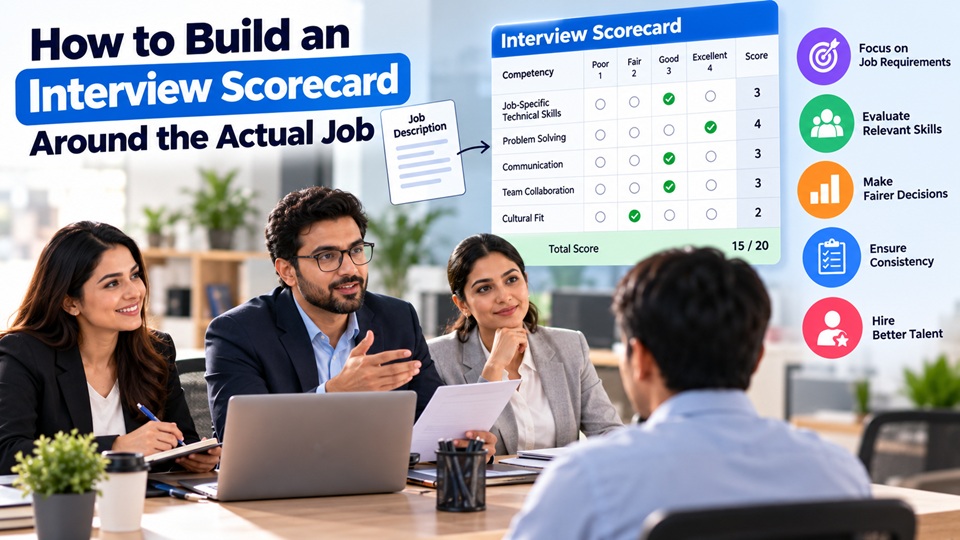
An interview scorecard gives a hiring team a shared place to record what it asked and what it learned. Its value depends on the questions behind the numbers. Begin with the work the new employee will actually do, then decide what evidence would help you assess readiness for that work.
For a retail role, the relevant tasks might include explaining products, checking deliveries, or organizing a shift. Write these responsibilities plainly before turning them into interview questions. This gives the scorecard a practical connection to the vacancy.
Choose a manageable set of responsibilities
Separate the tasks expected from the beginning from those that will be taught after joining. Discuss that distinction with the person who will supervise the role. An interview should not quietly become a test of internal procedures that applicants have never had a chance to learn.
Take receiving a delivery as an example. The team might want evidence that someone can compare items with a record, notice a discrepancy, and explain what they would do next. Those actions provide a more useful starting point than an undefined requirement to be "detail oriented."
Prepare questions and evidence notes together
Write a question that invites the candidate to explain an example or work through a relevant situation. Beside it, note the details the interviewer should listen for. Keep the question focused enough that there is time to explore the answer.
The headoffis interview scorecard template combines editable questions, notes about what a good answer shows, and a one-to-five score for each response. You can print a sheet or score answers on screen without an account. Save a draft file if you want to reopen the scorecard later.
Agree on how the scale will be used
Before meeting candidates, have the interviewers discuss a few imaginary responses to the same question. Compare the scores they would give and ask what evidence explains the difference. Resolve unclear criteria while the scorecard is still a draft.
For the delivery example, a response might describe counting items but say nothing about handling a mismatch. Record that missing detail explicitly. A different response might explain checking the record, setting aside the disputed items, and contacting the appropriate person. The notes should show why those answers received different assessments.
Leave room for useful follow-up
Plan a common set of core questions and leave time for clarification. A follow-up such as "What was your part in that task?" can help distinguish an individual's contribution from a team's work. Record any detail needed to understand the answer later. Reserve time for candidates to ask about the role and working arrangements, separately from the questions you are scoring.
Keep observations separate from conclusions. "Described checking the order number before accepting a replacement" records evidence. "Seems reliable" is an interpretation that needs supporting detail. If an answer remains unclear, note the uncertainty instead of filling the gap with an assumption.
Review evidence before the overall decision
After the interview, check that each score has an explanation. Mark questions that were not covered so an incomplete interview is not mistaken for a complete assessment. Where several interviewers participated, ask each to record their observations before discussing the candidate together.
Use the discussion to examine differences in the evidence and its interpretation. A total score can summarize the sheet, but it does not explain every strength or unanswered question. Return to the responsibilities of the role when deciding which observations matter most.
Keep a record of the scorecard version used for the interviews. If a question repeatedly fails to produce useful information, note that for the next hiring process. Deliberate revision gives the team a clearer basis for future interviews while preserving the context of the ones already completed.