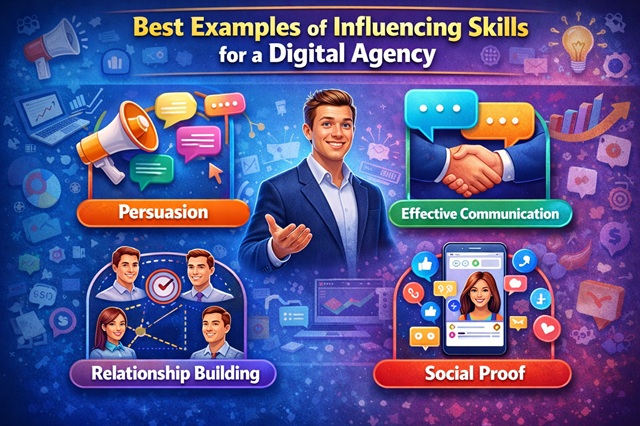
Influencing skills are the hidden force behind every successful digital agency. Tools, platforms, automation, and creative talent matter—but they don’t move projects forward on their own. Digital agencies operate in an environment where they must constantly influence decisions without having final authority. They influence clients to trust strategies, approve technical changes, accept timelines, and stay patient while results compound. They influence users through UX, messaging, and performance data. They influence internal teams to collaborate across disciplines under pressure.
In a digital agency, influence is not hype, manipulation, or overpromising. It is the ability to align expectations, decisions, and behavior with reality—clearly, ethically, and consistently. Agencies that master influence become long-term partners. Those that don’t are treated as replaceable vendors.
This article explores the best examples of influencing skills for a digital agency, grounded in real workflows and everyday challenges across SEO, paid media, web development, analytics, and UX.
What Influencing Skills Mean in a Digital Agency
For a digital agency, influence is the ability to:
- Guide client decisions without direct control
- Secure buy-in for technical and strategic work
- Manage expectations before measurable results appear
- Influence user behavior ethically through digital experiences
- Align multidisciplinary teams around priorities
Digital agencies sit between complex technology and non-technical decision-makers. Influence is the bridge.
1. Influencing Clients to Trust Strategy Over Assumptions
Many clients arrive with fixed ideas: “We just need more traffic,” “SEO is dead,” or “Let’s copy what competitors do.” Strong digital agencies influence by educating rather than agreeing.
Example:
A client wants to increase ad spend without fixing site performance. The agency explains how page speed, UX friction, and tracking gaps limit ROI. By visualizing funnel data and benchmarks, the agency secures approval for technical improvements first.
Influence comes from clarity, not compliance.
2. Influencing Expectations About Timelines and Results
Digital growth rarely happens overnight. SEO, CRO, and product-led growth require time. Influential agencies manage expectations before work begins.
Expectation management prevents conflict later.
Example:
Before launching an SEO campaign, the agency explains indexing delays, algorithm volatility, and compounding growth phases. When results take time, the client remains calm because the reality was communicated upfront.
Expectation-setting is one of the strongest influencing skills in digital work.
3. Influencing Clients to Value Data Over Opinion
Digital agencies often face subjective feedback: “I don’t like this design,” “This copy feels wrong,” or “That ad doesn’t match our brand.” Influence shifts decisions from taste to evidence.
Example:
A client dislikes a landing page variation that outperforms others. Instead of debating aesthetics, the agency presents conversion data, heatmaps, and session recordings. The client agrees to keep the winning version live.
Data-driven influence reduces emotional decision-making.
4. Influencing Buy-In for Technical Work
Technical tasks—tracking setup, site migrations, schema, refactoring—are often undervalued because clients don’t “see” them. Influential agencies translate technical impact into business outcomes.
Example:
Instead of asking for time to “fix analytics,” the agency explains how inaccurate data leads to wasted ad spend and poor decisions. The client approves the work because the value is clear.
Influence turns invisible work into visible value.
5. Influencing Client Patience During Algorithm Changes
Algorithm updates, platform changes, and performance volatility are unavoidable. Agencies must influence clients to stay strategic instead of reactive.
This requires calm, confident communication.
Example:
After a Google update impacts rankings, the agency explains what changed, what’s within control, and what actions are planned. The client trusts the process instead of demanding panic fixes.
Stability influences trust during uncertainty.
6. Influencing UX and CRO Decisions Without Ego
UX and CRO work often triggers personal opinions. Influential digital agencies frame design decisions around user behavior, not personal preference.
Example:
A stakeholder wants a complex homepage layout. The agency demonstrates how simpler layouts improve task completion and conversions using user testing data. The final design aligns with user needs.
User-centered influence beats opinion-driven debate.
7. Influencing Cross-Functional Client Teams
Digital agencies frequently work with marketing, product, sales, IT, and leadership teams—each with different priorities. Influence requires translation.
Example:
The agency explains how SEO improvements support sales enablement and product visibility, not just traffic. Sales and product teams support the initiative because they see direct relevance.
Influence grows when digital work is tied to business outcomes.
8. Influencing Ethical User Behavior Online
Digital agencies influence millions of user decisions through design, messaging, and funnels. Ethical influence respects the user while guiding action.
Dark patterns damage trust and long-term growth.
Example:
Instead of deceptive countdown timers, the agency designs transparent urgency through limited-time value offers. Conversion rates increase without harming brand credibility.
Ethical influence builds sustainable performance.
9. Influencing Internal Agency Teams Across Disciplines
Digital agencies bring together strategists, developers, designers, SEO specialists, and media buyers. Silos reduce effectiveness. Influence aligns priorities without micromanagement.
Example:
An agency lead explains how a unified roadmap improves delivery speed and results. Teams collaborate instead of competing for attention.
Alignment influences execution quality.
10. Influencing Client Retention Through Communication
Many digital agencies lose clients not because of results, but because of silence. Influence is sustained through consistent communication.
Example:
The agency provides regular updates explaining tests run, lessons learned, and next steps—even when metrics are flat. Clients stay engaged because they feel informed.
Transparency sustains influence.
11. Influencing Pricing and Scope Conversations
Digital agencies often struggle with scope creep and underpricing. Influential agencies confidently frame pricing around value and outcomes.
Example:
Instead of billing by hours, the agency explains how scope relates to impact, risk, and results. Clients who value outcomes accept the pricing.
Value-based influence attracts the right clients.
12. Influencing Buy-In for Long-Term Digital Strategy
Short-term wins are easier to sell than long-term digital foundations. Influential agencies help clients think beyond immediate metrics.
Example:
The agency shows how consistent technical SEO, content depth, and UX improvements compound over time using real case studies. The client commits to a longer partnership.
Vision influences commitment.
13. Influencing Through Case Studies and Proof
Promises rarely persuade experienced clients. Proof does. Digital agencies influence decisions through concrete examples and lessons learned.
Example:
Instead of pitching abstract ideas, the agency demonstrates how similar clients improved retention or CAC through specific changes.
Evidence removes skepticism.
14. Influencing Difficult Conversations About Failure
Not every experiment works. Influential agencies own outcomes without defensiveness.
Honest failure management builds trust.
Example:
The agency explains why a test failed, what data revealed, and how strategy will adapt. The client stays because transparency outweighs perfection.
Integrity strengthens influence.
15. Influencing Agency Reputation at Scale
Influence compounds through reputation. Every proposal, report, and interaction shapes how the agency is perceived.
Strong reputation reduces sales friction.
Example:
The agency becomes known for honesty, technical depth, and clear communication. Prospects arrive already trusting the agency.
Reputation is influence multiplied.
Why Influencing Skills Matter for Digital Agencies
Digital agencies face:
- Rapid platform and algorithm changes
- Technically complex work
- Clients with strong opinions
- Delayed ROI cycles
- High competition
Without influencing skills, agencies become task executors. With influence, they become strategic partners.
Influence helps digital agencies:
- Secure strategic buy-in
- Protect long-term vision
- Retain clients longer
- Improve execution quality
- Scale trust and reputation
Final Thoughts
The best digital agencies don’t rely on buzzwords, overpromising, or technical intimidation. They influence through clarity, credibility, education, and ethical leadership.
Influencing skills allow digital agencies to guide decisions without controlling them, manage uncertainty without panic, and build partnerships that outlast individual projects.
In digital work, influence is not optional—it’s the difference between being hired for tasks and being trusted for strategy.