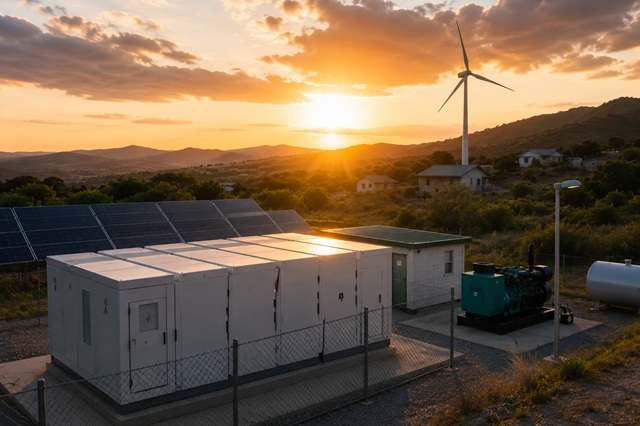
 Remote power problems often get the same old answer: add more generator runtime. It works, but it is not elegant. Fuel deliveries are expensive, maintenance never disappears, and generators are often inefficient when they run far below their ideal load. Battery storage gives off-grid and hybrid sites another option.
What Storage Does in a Microgrid
A microgrid is a local power system that can operate independently or alongside the main grid. It may include solar, batteries, generators, controls, and site loads. In remote sites, the microgrid is not a backup plan. It is the power system. A BESS stores energy when production exceeds demand and releases it when demand rises. It can also respond quickly to sudden load changes, helping the system stay stable. The National Renewable Energy Laboratory has described batteries as useful for renewable integration, peak reduction, and resilience in microgrid applications. In plain terms, the battery helps the site use more of its own solar and run generators less awkwardly.
Diesel Still Has a Role, But Not Every Role
Diesel generators are useful because fuel can provide long-duration energy. The problem is using them for every small fluctuation. Running a generator lightly loaded for long periods can waste fuel and increase maintenance. With storage, the generator can run at a more efficient output, charge the battery, and shut down when loads are lighter. Solar can charge the battery instead of being curtailed at midday. Short spikes can be handled by the battery rather than by starting another generator. The International Energy Agency reported in 2024 that battery costs had fallen about 90 percent over 15 years. That cost decline is one reason hybrid microgrids are easier to evaluate against diesel-only expansion.
The Controller Is the Brain
A microgrid is not just hardware. It needs a control layer that decides when to use solar, when to charge batteries, when to start generators, and which loads deserve priority. That is where a DC-coupled microgrid gateway can be important. Sigenergy describes its Business Energy Gateway as supporting intelligent energy management, backup operation, parallel operation, and DC-coupled microgrid design. Those functions are relevant when storage, solar, and generators need to work as one coordinated system.
Modularity Helps Remote Projects
Remote loads change. A farm adds cold storage. A resort adds charging carts. A telecom site adds electronics. A manufacturing site adds a new production line. Modular storage can let the project expand without replacing the entire power architecture. It can also simplify logistics. Moving several modular components may be easier than transporting and placing one oversized system, especially where site access is limited. The best candidates for BESS-supported microgrids usually have high fuel costs, good solar resource, variable loads, outage-sensitive operations, or plans to electrify more equipment. A modular BESS platform can help match storage capacity to those changing conditions.
The Goal May Be Less Diesel, Not No Diesel
Going fully diesel-free is not always the first practical milestone. Reducing runtime may be enough to lower fuel cost, reduce maintenance, and improve reliability. The generator can remain as long-duration insurance while the battery handles daily cycling, fast response, and solar shifting. That is usually the smarter conversation: not whether storage replaces every generator immediately, but whether it can stop the generator from doing jobs a battery handles better.