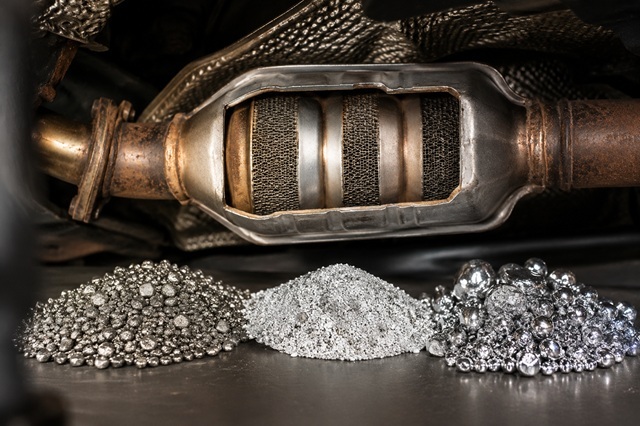
Two catalytic converters can look almost identical yet receive dramatically different purchase offers. That difference is rarely arbitrary. A converter’s value is influenced by its recoverable platinum, palladium, and rhodium content, and each of these platinum-group metals has a distinct market price, industrial role, and recovery profile.
For vehicle dismantlers, repair shops, scrap dealers, and individual sellers, understanding these differences makes it easier to assess offers and avoid relying on weight or appearance alone. It also explains why professional buyers use identification databases, laboratory analysis, and current commodity data rather than a simple price-per-unit calculation.
What Precious Metals Do Inside a Converter
A catalytic converter reduces harmful exhaust emissions through chemical reactions. Its ceramic or metallic core is coated with a catalyst layer containing small quantities of precious metals. Platinum, palladium, and rhodium are especially useful because they tolerate high temperatures and accelerate reactions without being consumed as ordinary fuel would be.
The metals do not perform exactly the same job:
- Platinum supports oxidation reactions that convert carbon monoxide and unburned hydrocarbons into less harmful substances.
- Palladium is highly effective in oxidation reactions and is widely used in petrol-engine emission systems.
- Rhodium is particularly important for reducing nitrogen oxides into nitrogen and oxygen.
Manufacturers adjust the proportions according to engine type, vehicle model, emissions standard, production year, catalyst design, and prevailing metal costs. Consequently, there is no universal precious-metal formula for every converter.
Why Platinum Affects an Offer
Platinum is one of the best-known precious metals, but name recognition does not automatically make a platinum-rich converter the most valuable. The offer depends on how much platinum the unit is expected to contain, its current market value, and the practical recovery yield.
Platinum has historically been associated with diesel oxidation catalysts, although formulations vary considerably. A large diesel converter may contain meaningful platinum content, but size alone is not proof of value. Some physically smaller units can have a more valuable catalyst coating, while large housings may contain relatively modest concentrations.
Platinum prices also respond to mining output, automotive demand, investment activity, recycling supply, and demand from sectors such as chemicals, glass, and jewellery. A valuation based on an old price list may therefore fail to reflect present conditions.
Why Palladium Can Shift Values Quickly
Palladium has been extensively used in petrol-powered vehicles. During periods of strong automotive demand or constrained supply, changes in its market price can noticeably affect converter offers. A unit known to have a palladium-rich formulation may rise or fall in estimated value even though its physical condition appears unchanged.
Substitution adds another layer of complexity. Vehicle manufacturers may alter catalyst recipes when one metal becomes expensive relative to another. However, redesigning and certifying an emissions system takes time, so substitution is not immediate. This delay can create periods in which demand remains high despite elevated prices.
Sellers should therefore be cautious when applying a headline palladium price directly to a converter. Commodity quotations generally refer to refined metal, not the gross weight of a used component. Processing costs, sampling, expected recovery rates, refining terms, and the buyer’s settlement method must all be considered.
Why Rhodium Has an Outsized Impact
Rhodium is usually present in much smaller quantities than platinum or palladium, but its price can be exceptionally high and volatile. Even a modest variation in rhodium loading can significantly change a converter’s theoretical value.
This is one reason visual estimates are unreliable. A buyer cannot determine rhodium concentration by examining the shell, checking the colour of the substrate, or weighing the entire unit. The steel housing, insulation, ceramic core, contamination, and catalyst coating all contribute to weight, while only a tiny fraction may consist of rhodium.
Rhodium supply is concentrated and relatively limited, while its role in controlling nitrogen oxide emissions is technically important. In a small market, changes in mine supply, industrial demand, or inventories can result in pronounced price movements. Professional valuations should therefore use recent market references instead of assumptions drawn from a previous sale.
Why Similar-Looking Converters Receive Different Offers
Precious-metal prices are only part of the calculation. Reliable buyers typically assess several factors together:
- Part number and identity: Stamped codes may connect a unit to a known vehicle and catalyst formulation.
- Reference data: A chemically analysed database can indicate the expected platinum, palladium, and rhodium content of a specific model.
- Completeness: A cut, emptied, damaged, or contaminated converter may produce a different return from an intact unit.
- Sampling and analysis: Mixed lots or unidentified material may require laboratory testing rather than catalogue pricing.
- Market timing: Metal quotations and currency movements can alter settlement values.
- Recovery and refining terms: Theoretical metal content is not identical to the amount ultimately recovered and payable.
Metalbee addresses this complexity through an up-to-date database of more than 30,000 chemically analysed converters, supported by laboratory methods and experienced technicians. For sellers seeking catalytic converter purchasing in Riga (katalizatoru uzpirkšana riga), this data-led approach can provide a more defensible basis for evaluation than appearance-based estimates.
How Sellers Can Compare Offers More Confidently
Record identifying information
Before requesting a quote, photograph the complete converter and any readable stamps, manufacturer marks, or part numbers. Include the vehicle make, model, engine, fuel type, and year when known. Better information can reduce uncertainty and help the buyer identify the correct reference.
Ask how the valuation was produced
A professional quote should be explainable. Ask whether it is based on a part-number database, laboratory analysis, an assay of a processed batch, or a broad category. For larger or mixed-volume sales, also clarify sampling procedures, payment timing, deductions, and whether market prices are fixed at delivery or settlement.
Compare terms, not just the headline figure
The highest advertised number is not always the best final outcome. Consider documentation, weighing accuracy, analytical transparency, transaction security, payment speed, and the buyer’s ability to handle the material responsibly. A slightly different headline offer may be preferable if its conditions are clear and the settlement is dependable.
Keep other scrap streams separate
Catalytic converters should not be valued as ordinary steel or mixed scrap. Likewise, copper cable, aluminium rims, starters, alternators, brass, and other recyclable materials have their own grades and market drivers. Sellers monitoring non-ferrous metal prices (krāsaino metālu cenas) should sort materials wherever practical and request category-specific assessments. Metalbee also purchases a range of non-ferrous waste in Latvia, making it possible for eligible sellers to discuss several material streams while keeping their valuations distinct.
Accurate Valuation Supports Responsible Recycling
Recovering platinum-group metals reduces pressure on primary mining and returns scarce resources to productive use. Accurate assessment also supports recycling because sellers are more likely to use legitimate channels when pricing is transparent and traceable.
Ultimately, converter offers differ because platinum, palladium, and rhodium are not interchangeable line items. Their concentrations vary by converter, their market prices move independently, and their recoverable quantities require informed identification or analysis. If you have an individual unit or a commercial batch, gather the available part numbers and material details, then ask Metalbee for a documented evaluation. A data-driven conversation is the most practical way to understand what you have, why it is valued that way, and how it can re-enter the circular economy responsibly.